On Truth by Harry Frankfurt
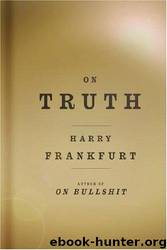
Author:Harry Frankfurt
Language: eng
Format: mobi, epub
Publisher: Vintage Digital
Published: 2010-01-24T23:00:00+00:00
V
Human beings are, by ancient definition, rational animals. Rationality is our most distinctive characteristic. It differentiates us essentially from creatures of all other kinds. Moreover, we have a powerful inclination, and we have convinced ourselves that we also have some convincing reason, to regard our rationality as making us superior to them. It is, in any case, the characteristic of which we humans are most insistently and most stubbornly proud.
However, we could not properly consider ourselves to be functioning rationally at all if we did not acknowledge the difference between being true and being false. To be rational is fundamentally a matter of being appropriately responsive to reasons. Now, reasons are constituted of facts: the fact that it is raining constitutes a reason—not necessarily, of course, a conclusive reason—for individuals who are in the region where it is raining, and who prefer to remain dry, to carry umbrellas. Any rational person who understands both what rain is and what umbrellas do will recognize this. To make the same point a bit differently: the fact that it is raining in a certain region means that there is a reason for people in that region to carry umbrellas if they wish to avoid getting wet.
Only if it is truly a fact that it is raining in the specified region—and so, only if the statement “it is raining in the region at issue” is true—can either the fact of the matter or the statement thereof give anyone a reason to carry an umbrella. False statements provide no rational support for anything; they cannot effectively serve anyone as reasons. Of course, a person might display his intellectual virtuosity by drawing out(i.e., deducing) the implications of false statements—by showing, in other words, what conclusions those statements would rationally warrant if they were actually true rather than false. This display of agility and power in deductive reasoning might be an entertaining and even, perhaps, an impressive exercise; it might possibly serve, as well, to nourish in its performer a certain insubstantial, hollow vanity. Under ordinary conditions, however, there would not be much point to it.
The notions of truth and of factuality are indispensable, then, for imbuing the exercise of rationality with meaningful substance. They are indispensable even for understanding the very concept of rationality itself. Without them, the concept would have no meaning, and rationality itself (whatever it might turn out to be, if anything, in such deprived conditions) would be of very little use. We cannot think of ourselves as creatures whose rationality endows us with an especially significant advantage over others—indeed, we cannot think of ourselves as rational creatures at all—unless we think of ourselves as creatures who recognize that facts, and true statements about the facts, are indispensable in providing us with reasons for believing (or for not believing) various things and for taking (or for not taking) various actions. If we have no respect for the distinction between true and false, we may as well kiss our much-vaunted “rationality” good-bye.
Download
This site does not store any files on its server. We only index and link to content provided by other sites. Please contact the content providers to delete copyright contents if any and email us, we'll remove relevant links or contents immediately.
| Anthropology | Archaeology |
| Philosophy | Politics & Government |
| Social Sciences | Sociology |
| Women's Studies |
The remains of the day by Kazuo Ishiguro(8968)
Tools of Titans by Timothy Ferriss(8362)
Giovanni's Room by James Baldwin(7319)
The Black Swan by Nassim Nicholas Taleb(7103)
Inner Engineering: A Yogi's Guide to Joy by Sadhguru(6785)
The Way of Zen by Alan W. Watts(6594)
Asking the Right Questions: A Guide to Critical Thinking by M. Neil Browne & Stuart M. Keeley(5752)
The Power of Now: A Guide to Spiritual Enlightenment by Eckhart Tolle(5744)
The Six Wives Of Henry VIII (WOMEN IN HISTORY) by Fraser Antonia(5495)
Astrophysics for People in a Hurry by Neil DeGrasse Tyson(5174)
Housekeeping by Marilynne Robinson(4434)
12 Rules for Life by Jordan B. Peterson(4299)
Double Down (Diary of a Wimpy Kid Book 11) by Jeff Kinney(4257)
The Ethical Slut by Janet W. Hardy(4241)
Ikigai by Héctor García & Francesc Miralles(4237)
Skin in the Game by Nassim Nicholas Taleb(4235)
The Art of Happiness by The Dalai Lama(4120)
Skin in the Game: Hidden Asymmetries in Daily Life by Nassim Nicholas Taleb(3987)
Walking by Henry David Thoreau(3950)
